
This summer someone on r/popculturechat shared a video essay in a thread titled "Why Every Brand Feels Like a Cult Now." Their summary of the video: we're lonely as a society, and brands fill the hole left by a lack of community. The example was Hailey Bieber's skincare brand, Rhode.
r/popculturechatJul 3, 2026Why Every Brand Feels Like a Cult Now
I thought this was a fascinating video that goes into why people act like this more and more with brands.
TLDW: we are lonely right now as a society and it is a way to fill that hole we feel from lack of community. She uses Hailey Bieber and Rhode as an example.
I was interested to see what y’all think about this as well!
▲ 80💬 21
You've heard the word used about CrossFit, Apple, Supreme and Peloton. People mean it as a joke, or as an insult. Psychiatry has a precise checklist for it, and the man who wrote that checklist was studying something much darker than skincare.
In April 1952 Professor Chin Yüeh-lin, who had spent years studying in the United States, mostly at Harvard, and was "regarded as China's leading authority on formal logic," published a confession in a Beijing newspaper. It was written during the Communist government's thought reform campaign of 1951 and 1952. In it he wrote that "for thirty years I played a game of concepts." China's top logician was renouncing his own life's work, in print.
A young American psychiatrist reprinted that confession at the back of a book. That book explains a lot about why people buy.
Who was Robert Jay Lifton?
Robert Jay Lifton was an American psychiatrist who lived from 1926 to 2025. From 1951 to 1953 he served as an Air Force psychiatrist in Japan and Korea, during the Korean War. His research started in 1953 with interviews with American servicemen who had been held captive in that war, men whom Chinese captors had pushed into making demonstrably false statements.
Lifton wanted to know how that actually worked. In 1954 and 1955 he ran a research project in Hong Kong, where people released from mainland China were arriving. He interviewed 25 Americans and Europeans who had been through "thought reform," most of them in Chinese prisons, and 15 Chinese who had fled after being put through it in universities.
What he found was less like science fiction than the word "brainwashing" suggests. In his account the method was mostly social: a closed environment, a group, a vocabulary, a set of rules about what was pure, and constant pressure to confess. Over weeks and months, ordinary people changed what they said, and some changed what they believed, for a while. Lifton found that the POWs' thinking soon went back to normal once they were home.
The result was Thought Reform and the Psychology of Totalism, published by W. W. Norton in 1961. Most of the book follows individual people through their interrogations. Near the end, in a chapter called "Ideological Totalism," Lifton answers the question he says people kept asking him: "Isn't this just like 'brainwashing'?"
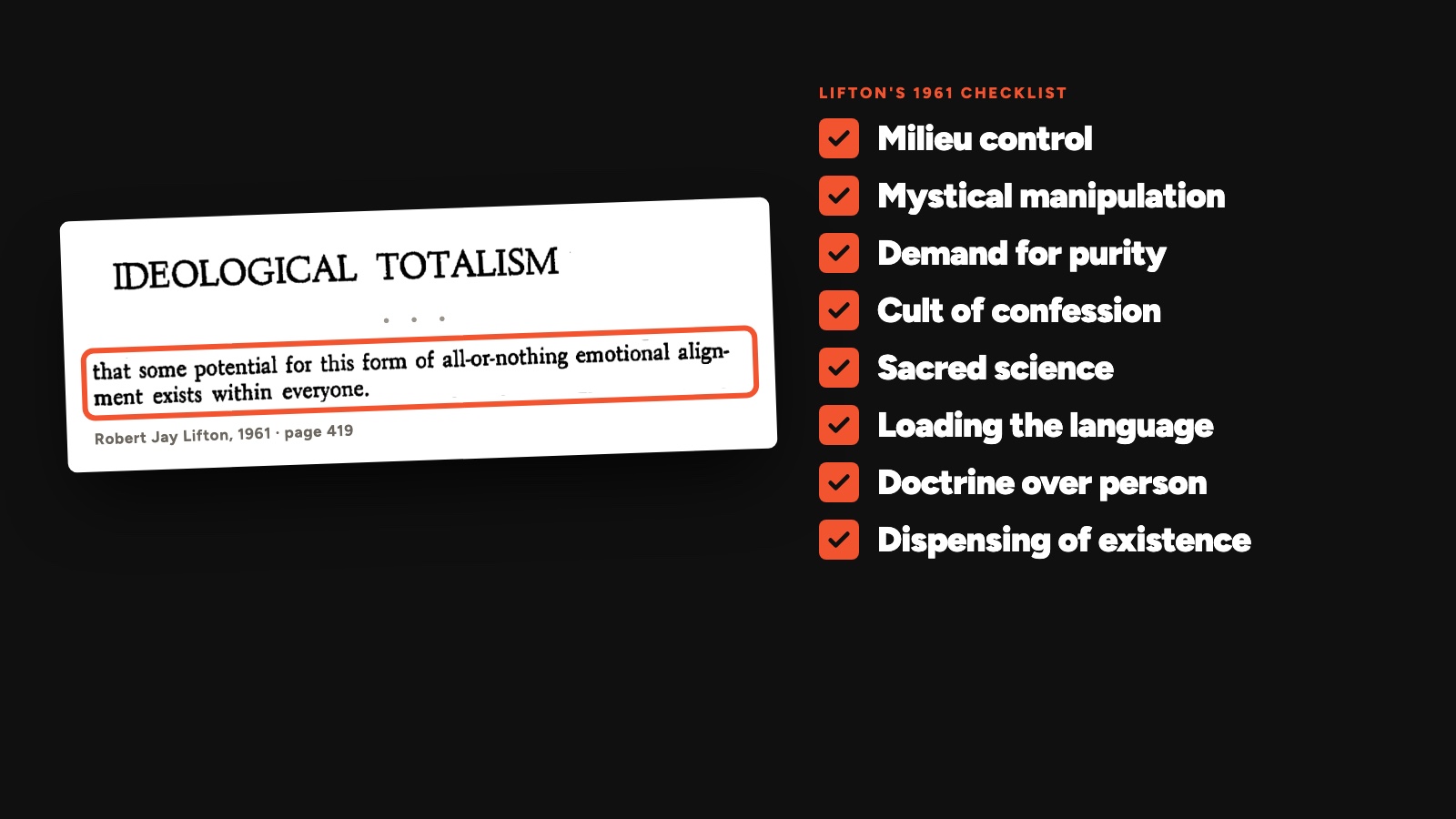
His answer was eight criteria any environment could be judged against. They're still used today to judge whether a group has become cultish. In 2021 the linguist Amanda Montell used one of Lifton's ideas, the thought-terminating cliché, in her book Cultish, which looks at the language of groups from SoulCycle to 12-step programs to Instagram influencers.
The important part for anyone selling something is a single sentence on the chapter's first page. Lifton wrote that "some potential for this form of all-or-nothing emotional alignment exists within everyone." These pulls aren't reserved for prisoners. They're in all of us, at different strengths. Lifton also wrote that an environment built on these pulls "may temporarily energize or exhilarate," while posing what he called "the gravest of human threats." The pull is real, and so is the danger.
That's why people join things. It's also why people buy things. Here are the eight, what each looks like when a brand runs a mild version, and where each one crosses a line.
1. Milieu control: how Harley-Davidson saved itself by building a room
Lifton's first criterion is the base everything else sits on: "the control of human communication." In a prison, that meant controlling what people saw, heard and said, down to what they told themselves.
In 1981 Harley-Davidson was close to dead. Under its owner, the leisure-goods company AMF, sales and quality had slid so far that the company almost went bankrupt, while Honda, Kawasaki, Suzuki and Yamaha took the American market. That year AMF sold Harley to 13 investors led by Vaughn Beals and Willie G. Davidson.
Two years later, in 1983, the new owners built something the Japanese companies didn't have: the Harley Owners Group, created to tie customers, employees and the company together. Every chapter is linked to a sponsoring Harley dealership. Chapters put out their own newsletters, and most of their events are member-only rides. Today the club has over a million members, the largest factory-sponsored riding club in the world, and members typically spend 30% more than other Harley owners. The community effort is credited with turning Harley's sales around.
Harley never controlled what its riders heard. It did build the room where much of that conversation happens, and hosted it.
What that means for your ads: most ads show the product alone, so the customer has to imagine who else owns it. Show them instead. Your customers together at an event, in a group chat, in a Facebook group, at a meetup. An ad like that sells the room the product gets them into. If you have no community yet, the angle tells you what to build first.
Where it turns ugly: when you want to be the only voice your customer hears, and treat every outside review or competitor as an attack.
2. Mystical manipulation: the $30 brick that sold out
Lifton's second criterion has the best name on the list. He describes manipulation that's planned from above but designed to look like it came from inside the group. He calls it "planned spontaneity."
James Jebbia opened the first Supreme store in a former office on Lafayette Street in Lower Manhattan in April 1994. Instead of putting out a whole season at once, Supreme releases a small group of products every Thursday. It invented that model, the "drop," which is now widely used across the industry.
In 2016 Supreme dropped a red clay brick with its logo stamped in the middle. The price was $30. It sold out, and within hours of selling out it was listed on eBay for $1,000. Four years later, VF Corporation agreed to buy Supreme for $2.1 billion.
The line outside a Supreme store on a Thursday looks spontaneous. The release calendar planned every bit of it. And because the calendar is real, with real dates and real limits, the crowd keeps coming back.
What that means for your ads: scarcity works when it's true and when people can plan around it. Announce a limited run with a real number, a real date and a real reason it's limited (a small batch, a seasonal ingredient, a collaboration). Then run the countdown ads: 40 left, Ships Friday, Last batch of the year.
Where it turns ugly: fake scarcity, like a countdown timer that restarts every time the page reloads. Customers notice, and after that your "limited" means nothing.
3. The demand for purity: the soap that was 99 44/100% pure
In the thought reform environment, Lifton wrote, "the experiential world is sharply divided into the pure and the impure." Good and bad, with nothing in between, and a constant hunt for whatever is making you impure.
In 1879 James Norris Gamble, a chemist and the son of Procter & Gamble's co-founder, developed an inexpensive white soap the company named Ivory. Harley Procter wanted to prove it was purer than the castile soap people were buying at the time, so he hired an independent laboratory to test it. The result became one of the most famous lines in American advertising: "99 44/100% Pure," in use by 1895.
Ivory's purity claim worked for the same reason Lifton's purity demand did: it split the world in two, Ivory and everything else. The difference is that Ivory's came with a number and a lab behind it.
Compare today's beauty aisle. Clean skin care is a billion-dollar industry, NPR reported in 2021, but there's no formal definition of what makes a product clean and no governing body regulating the label. The word does the dividing, and nobody has to prove anything.
What that means for your ads: purity sells, and vague purity is everywhere, so be specific. Name exactly what you left out and why, the way Harley Procter put a number on his soap: No fragrance. Here's why we took it out. Three ingredients. Here they are. A specific claim stands out next to a shelf of products that all just say "clean."
Where it turns ugly: when the ad implies everything else on the shelf is poison. You win the sale by teaching the customer fear, and the next brand with a scarier list takes them from you.
4. The cult of confession: the woman someone mistook for pregnant
Lifton's subjects described confessing over and over, to real crimes and invented ones. He also saw what confession offered them: "the continuing opportunity for emotional catharsis," and an intense closeness with everyone else confessing.
In 1961, the same year Lifton's book came out, Jean Nidetch was a 38-year-old homemaker in Queens who weighed 214 pounds. She had tried pills, hypnosis and fad diets. Then an acquaintance mistook her for being pregnant.
Nidetch didn't buy another diet. She invited six overweight friends to her apartment to talk about it, every week. Within two months the group was 40 women, and every meeting included a weigh-in. When the first official Weight Watchers meeting opened in May 1963, 400 people showed up. The meetings still run as support groups built on empathy and mutual understanding. What people paid for was a room where they could say the hard part out loud, among people who had said it too.
What that means for your ads: the strongest testimonial starts with the confession. Lead with the moment the customer would never have posted before: the pregnancy question, the photo they untagged, the third failed attempt. Only then bring in the product. Real customer videos that open on the hard part tend to beat polished ones, because viewers recognize themselves in the confession.
Where it turns ugly: Lifton noticed that once confession becomes a performance, "the element of histrionic public display takes precedence over genuine inner experience." Scripted tears and staged before-and-after photos are that performance, and your customers can usually tell.
5. Sacred science: Jamie Lee Curtis and the yogurt that wasn't proven
The thought reform environment, Lifton wrote, wrapped its beliefs in sacredness while making "an exaggerated claim of airtight logic," complete with absolute scientific precision. Questioning it made you both wrong and unscientific.
Customers buy certainty too, and "clinically proven" is the commercial phrase for it. In 2010 Dannon hired Jamie Lee Curtis to front Activia. The TV ads said that Activia, eaten every day, was "clinically proven" to help regulate your digestive system in two weeks. The FTC disagreed: in its view, eating one serving a day was not clinically proven to do that. In December 2010 Danone settled and removed the words "clinically" and "scientifically proven" from Activia products. It also agreed to pay $21 million to 39 states that had investigated alongside the FTC.
The problem was a claim bigger than the evidence behind it.
What that means for your ads: show the mechanism, then show only the proof you actually have. Explain how the product works in a way a customer can picture, on screen if you can: what's inside, what it does, how long it takes. Then put a real number next to it: the test you ran, the number of customers, the study and what it measured. A modest claim a customer can check is worth more than a big one a regulator can.
Where it turns ugly: claiming proof you don't have. Activia had to strip those words off its own packaging.
6. Loading the language: why CrossFit named its workouts like hurricanes
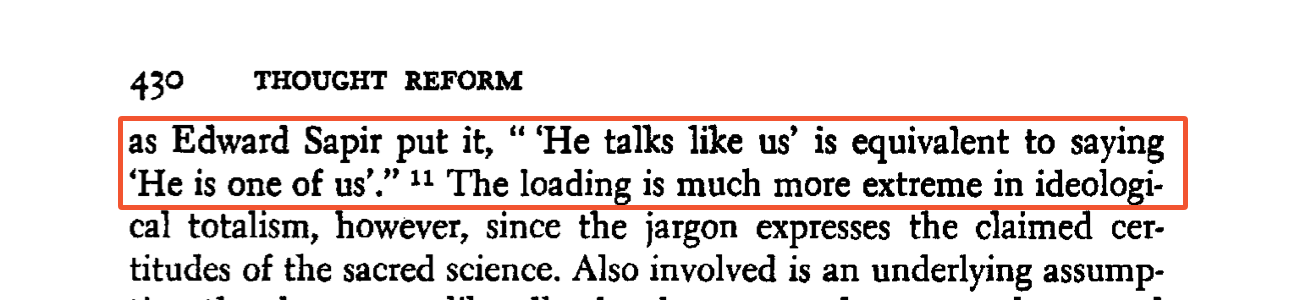
This is the criterion Lifton is best known for. His book has the earliest recorded definition of the "thought-terminating cliché": a short, definitive-sounding phrase that becomes "the start and finish of any ideological analysis." It sits under his sixth criterion, "loading the language." In the middle of that section is a line he borrowed from the linguist Edward Sapir.
Greg Glassman opened a gym in Santa Cruz, California, in 2001 and posted the workouts online for his clients. People who followed the posts started their own gyms, and the first affiliate, CrossFit North in Seattle, opened in 2002. Those gyms became "boxes." The daily workout became the "WOD."
In 2003 Glassman released the first benchmark workouts and gave them women's names: Angie, Barbara, Chelsea, Diane, Elizabeth and Fran. The idea was that they hit you like hurricanes. He called them "The Girls." Tell an outsider you did Fran in under five minutes and it means nothing. Say it in a box and everyone knows you're one of them. Harvard Divinity School's 2015 study How We Gather counted CrossFit, then at 4 million users, among the places young Americans now find the community they used to find in church.

What that means for your ads: your customers already have words for your product, their problem and each other. Find them in your reviews, comments, support tickets and the subreddits they post in, and write ads in those exact words. When a stranger's ad uses a customer's own word, the customer hears Sapir's line: he talks like us.
Where it turns ugly: when a phrase exists to stop questions. "Trust the process," said to a customer asking why it isn't working, is a thought-terminating cliché.
7. Doctrine over person: the billion-dollar bet on Herbalife's story
Lifton's seventh criterion is "the subordination of human experience to the claims of doctrine." When the doctrine and a person's experience disagree, the doctrine wins, and the person is told the problem is them.
In December 2012 hedge fund manager Bill Ackman called Herbalife, a maker of weight-loss and vitamin supplements, a pyramid scheme. His firm had bet $1 billion that its stock would fall. Herbalife had long been accused of deceiving distributors about how much they could earn, and about income coming mostly from recruiting rather than selling. A later documentary told the stories of distributors who lost their life savings.
In 2016 the FTC alleged that Herbalife had deceived people into believing they could earn substantial income from its business opportunity. Herbalife agreed to change its business model and pay $200 million to settle. For years the income story had outranked what distributors were actually earning. (Ackman, for his part, closed out his bet at a loss in 2018.)
What that means for your ads: the mild version of doctrine is a method, and customers like methods. A routine, a protocol or a program tells them exactly what to do. So sell the method, then show the real range of results next to it: the fast ones, the slow ones, and what you change for people it doesn't suit. Most customers notice it in two weeks, for some it takes six, and here's what we do if it doesn't work for you is more believable than any single transformation.
Where it turns ugly: when the method can't fail and only the customer can.
8. The dispensing of existence: Apple's emails about the green bubble
Lifton's last criterion is the darkest. The totalist environment, he wrote, draws a sharp line between people whose existence can be recognized and people who have no such right. In China that line was political, and it could be fatal.
The consumer version is mild, and in one case we can read the company's own reasoning. In 2013 Apple's software chief, Craig Federighi, worried in an email that putting iMessage on Android "would simply serve to remove [an] obstacle to iPhone families giving their kids Android phones." Phil Schiller, the Apple executive in charge of the App Store, wrote that "moving iMessage to Android will hurt us more than help us." Both emails surfaced in Epic Games' 2021 lawsuit against Apple.
The obstacle was a color. Texts from Android phones show up green instead of blue. Research firm Piper Sandler found that 87% of US teens it surveyed in 2021 owned iPhones, and the Wall Street Journal tied that to iMessage. When 19-year-old Adele Lowitz switched to Android, a friend in her group chat asked: "who's green?" Teens and college students told the Journal they dread being singled out over green texts.

What that means for your ads: people buy to stay inside a group they already belong to, or to get into one they want. Name that group plainly so the right people feel invited: for nurses on 12-hour shifts, for dads who coach, for people who've quit three gyms.
Where it turns ugly: when the ad mocks the people outside. It might sell this quarter, and it teaches your own customers to fear being the green bubble next time.
Is it manipulation to market like this?
The top reply on that r/popculturechat thread, with 125 upvotes, says it plainly.
r/popculturechatcomment · Jul 3, 2026Because corporate companies blatantly use psychological trends and data to prey on consumers
▲ 125
That's the right worry. Every story above meets something real people want: a room to belong to, a reason to act now, a cleaner life, a fresh start, certainty, words that mark them as insiders, an identity. None of those wants is fake. The question is whether you're meeting them or trapping people with them.
Lifton didn't end his book on the eight criteria. His last chapter describes the healthy alternative, which he calls "open" personal change, marked by "openness to the world" rather than by personal closure. Confession still happens there, but "the personal exposure is dignified by privacy and balance." Loyalty still happens too, as "a commitment made autonomously and in the face of alternatives, rather than as a compulsory loyalty."
That last line is the best test a brand has. The customers worth having are the ones who chose you while they could see every alternative. Here are three questions we'd ask of any ad built on these angles. Can a customer ask a hard question and get a straight answer? Can they leave without being shamed? Would every claim hold up in front of a regulator? If the answer to all three is yes, you're giving people something they want. If not, you're drifting toward the "where it turns ugly" half of every section above.
Frequently asked questions
How do brands use cult psychology in marketing?
Most use mild versions of the pulls psychiatrist Robert Jay Lifton listed in 1961. Harley-Davidson built an owners club with over a million members, Supreme invented the limited weekly "drop," and CrossFit gave its gyms and workouts an insider vocabulary. Each one meets a real want: belonging, scarcity, insider status. The line is crossed when the brand fakes it or shames people who leave.
What brainwashing techniques are used in advertising?
The mild versions of Lifton's eight criteria all show up in ads. "99 44/100% Pure" and "clean" sell purity. "Clinically proven" sells certainty, sometimes more than the evidence supports, as Activia found when it had to drop the words. Confessional testimonials, limited drops, insider language and us-versus-them identity all appear too. Lifton wrote that some potential for this pull exists in everyone.
What are Robert Jay Lifton's eight criteria for thought reform?
They're milieu control, mystical manipulation, the demand for purity, the cult of confession, sacred science, loading the language, doctrine over person, and the dispensing of existence. Lifton set them out in 1961 in Thought Reform and the Psychology of Totalism, after interviewing 40 people who had been through Chinese Communist thought reform. They're still used to judge whether a group is cultish.
What is a thought-terminating cliché in marketing?
It's a short, catchy phrase that ends a discussion instead of answering it. Lifton's 1961 book has the earliest recorded definition of the term: "the start and finish of any ideological analysis." It falls under his sixth criterion, loading the language. In marketing, "trust the process" said to a customer whose results aren't coming is one.
Why do some brands feel like cults?
Because they use mild versions of the pulls Lifton described: a community to belong to, private language, insider status and a clear line between members and outsiders. Lifton wrote that some potential for this all-or-nothing pull exists in everyone. CrossFit, with its boxes and WODs, and the Harley Owners Group, with over a million members, are common examples.
Is cult marketing manipulative?
It doesn't have to be. Belonging, certainty and a fresh start are real needs, and meeting them is fair. It becomes manipulation when a brand fakes scarcity, claims proof it doesn't have, or shames people who leave. Activia had to remove "clinically proven" from its products, and Herbalife paid $200 million to settle with the FTC.
What ad angles can I test in Meta ads based on psychology?
Lifton's eight criteria give eight separate angles: show the community, run a real limited drop, name what you left out, open a testimonial on the hard part, show the mechanism, write in your customers' own words, show your method with the real range of results, and name who it's for. Each is its own concept, so test them against each other.